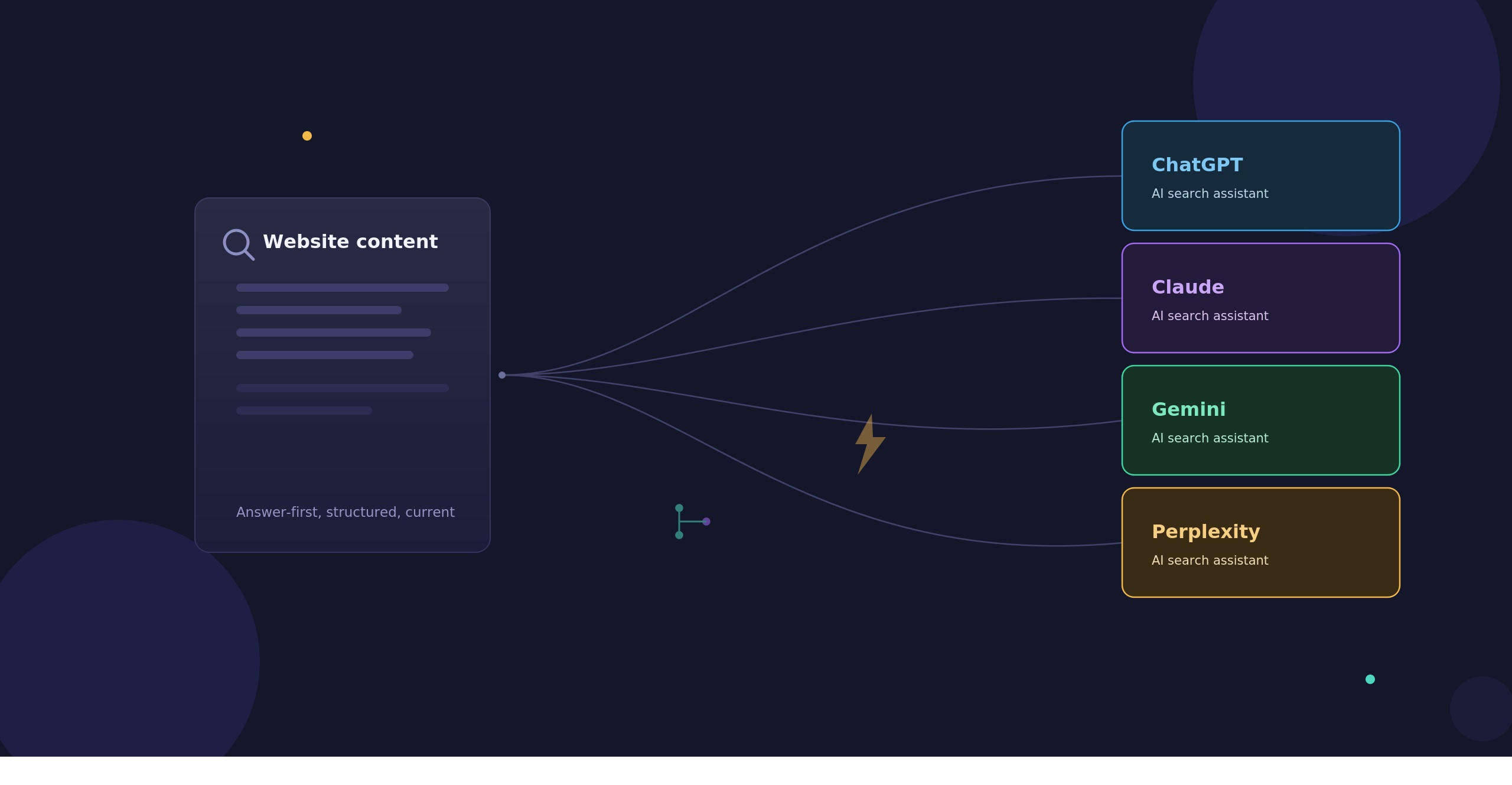
If you've noticed people asking ChatGPT or Claude for recommendations instead of typing into Google, you're not imagining it. Search behavior is shifting from "type keywords, click a blue link" to "ask a question, get a direct answer." That shift has created a new discipline: AI SEO, also called GEO (Generative Engine Optimization) or AEO (Answer Engine Optimization).
In this guide, we'll break down what AI SEO actually involves, why it matters even for a small business website, and the specific technical and content changes that help. We'll use real changes we made to this site as working examples throughout.
What Is AI SEO (GEO/AEO)?
Traditional SEO optimizes a page to rank in a list of search results. AI SEO optimizes a page to be cited as the source behind a direct answer. When someone asks an AI assistant "what's a good agency for X" or "how does Y work," the assistant pulls from a handful of sources to construct its answer — sometimes just 3 to 8 of them. Your goal is to be one of those sources.
The two disciplines overlap heavily. Helpful, well-structured, trustworthy content is still the foundation. But AI SEO adds a few extra layers on top:
- Making sure AI crawlers can actually access your site
- Structuring content so it can be lifted cleanly into an answer
- Giving machines explicit signals about what your business does
Why This Matters, Even for a Small Site
You don't need to outrank giant competitors on Google to benefit from AI SEO. AI answer engines don't work like a top-10 leaderboard — they select the clearest, most specific answer to the exact question being asked. A well-structured page from a small company can get cited over a vague page from a large one, if it answers the question more directly.
1. Let AI Crawlers Access Your Site
This sounds obvious, but it's the most commonly missed step. Your robots.txt file needs to explicitly allow AI crawlers — not just search engines. The main ones to check for:
GPTBotandChatGPT-User(OpenAI)ClaudeBotandClaude-Web(Anthropic)PerplexityBot(Perplexity)Google-Extended(Google's AI training signal)
It's also worth checking for anything outside robots.txt that might be blocking bots anyway — a firewall, CDN "bot fight mode," or JS challenge screen can silently block AI crawlers even when your robots.txt looks completely open. We found and fixed exactly this kind of mismatch on our own site during this process.
2. Add an llms.txt File
An llms.txt file is a simple Markdown file placed at your site's root (yoursite.com/llms.txt) that gives AI systems a clean, curated summary of your business and key pages — without the navigation, ads, and JavaScript clutter of a normal webpage. Think of it as a short briefing document written specifically for machines.
It's still an emerging standard with limited confirmed adoption by major AI providers so far, but it's low-cost to implement and future-facing.
3. Add Structured Data (Schema Markup)
Schema markup (written as JSON-LD) tells search engines and AI systems exactly who you are and what you offer, in a machine-readable format. The most useful types for a business site:
- Organization — your name, logo, founding date, contact info
- Service — for each service you offer
- Product — for anything you sell
- FAQPage — for question-and-answer content
Always validate schema with a tool like Google's Rich Results Test before publishing — malformed schema can do more harm than no schema at all.
4. Write Answer-First Content
AI systems favor content that answers a question directly and early, rather than making the reader (or the model) dig for it. A simple pattern: put a clear, self-contained 40 to 60-word answer directly under every heading, before any supporting detail. This one habit does more for AI visibility than almost any technical tweak.
5. Build a Real FAQ Page
A well-structured FAQ page is one of the highest-leverage pieces of AI SEO content you can build. Each question should be phrased the way a real person would actually ask an AI assistant — not generic marketing phrasing — with a direct answer of a few sentences, wrapped in FAQPage schema.
One easy mistake to avoid: don't duplicate the same questions and schema across multiple pages. Pick one canonical page per question, so search engines and AI systems aren't confused about which page is the authoritative source.
6. Keep Content Fresh
AI engines, like search engines, weight recently updated content more heavily. Add a visible "last updated" date to key pages, and actually revisit them periodically — a stale page from three years ago, even a good one, signals lower priority than something maintained today.
7. Earn Mentions Beyond Your Own Site
AI systems weigh how often and where you're mentioned across the web, not just your own site's content. Getting listed on relevant directories, contributing genuinely useful answers on platforms like Stack Overflow or Reddit, or being mentioned in guest posts all build the kind of external signal that both traditional SEO and AI SEO reward.
8. Monitor, Don't Guess
The only real way to know if any of this is working is to test it. Periodically ask ChatGPT, Claude, Gemini, and Perplexity questions a real customer might ask — and see if you show up, and for which questions. Pair that with your search console data for a fuller picture.
What Beginners Get Wrong
A few common mistakes worth avoiding as you get started:
- Treating AI SEO as separate from SEO. It's the same foundation of helpful, well-structured content, with a few extra technical layers — not a replacement discipline.
- Expecting overnight results. Indexing and citation take time to show up, and base-model knowledge only updates on the provider's own retraining schedule, which you don't control.
- Over-optimizing metadata and under-investing in content. Schema and technical fixes matter, but consistent, genuinely useful content and real backlinks do more heavy lifting over time.
- Forgetting to check the fundamentals. A blocked crawler or broken robots.txt setting makes every other optimization pointless — always verify access first.
How This Applies If You're Learning to Build This Yourself
If you're a developer or a small business owner learning this hands-on, the fastest way to build real understanding is to treat it as an ongoing loop, not a one-time project:
- Audit what you have (crawler access, schema, page structure)
- Fix the technical foundation first
- Add or restructure content to answer real questions directly
- Test regularly by actually asking AI assistants your target questions
- Adjust based on what you learn, and repeat
This is exactly the process we used to work through AI SEO on our own site, and it's the same approach we'd recommend to any developer or business owner starting from scratch.
Final Thoughts
AI SEO isn't a trend to chase and forget — it's becoming a permanent part of how people find information and businesses online. The good news is that the fundamentals are approachable: give AI systems access, tell them clearly what you do, answer real questions directly, and keep everything current. None of it requires a massive budget — just consistency.
If you're working through this on your own site and want a second set of eyes on your setup, feel free to get in touch — this is exactly the kind of technical and content work we help clients with.